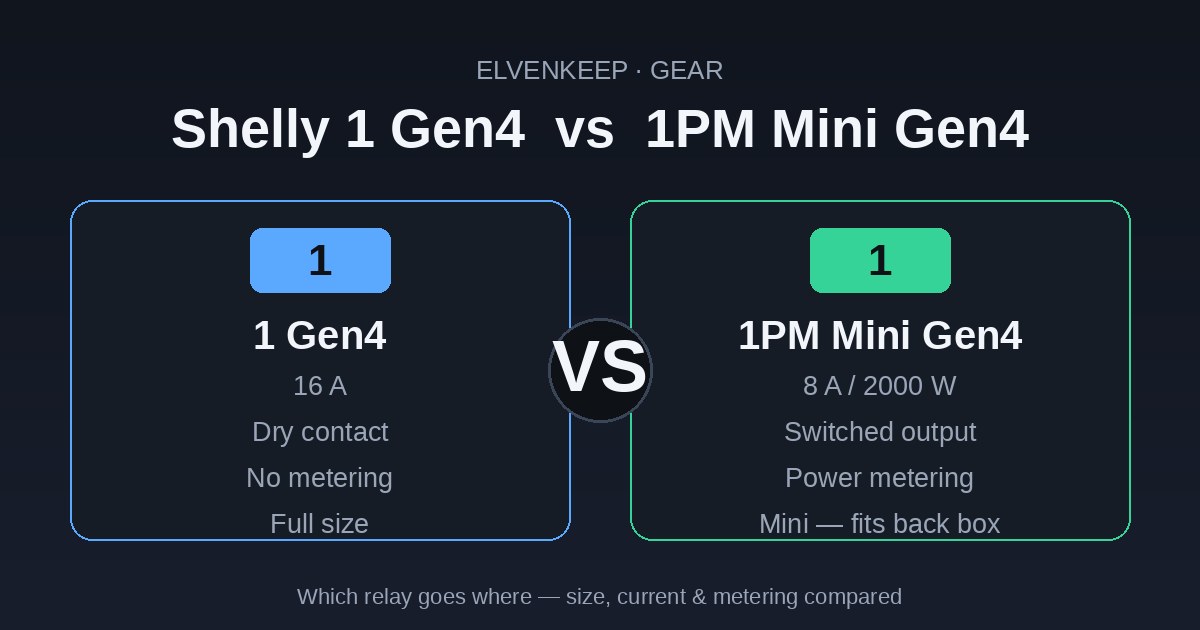
If you’ve shopped Shelly’s Gen4 line recently you’ve probably hit the same wall I did: there are now four “Shelly 1” relays that all sound nearly identical. The two people ask me about most are the full-size Shelly 1 Gen4 and the tiny Shelly 1PM Mini Gen4. They look like the same product in two sizes — but they actually differ on three things at once, and picking the wrong one means either a relay that won’t fit your wall box or one that can’t carry your load. Here’s how I decide.
Disclosure: some links on this page may become affiliate links. If you buy through them, I earn a small commission at no extra cost to you.
Same family, three differences at once
The confusing part is that these two aren’t a clean “big vs small” pair. Going from the 1 Gen4 to the 1PM Mini Gen4 changes the size, the maximum current, and whether you get power metering — all in one step. So it helps to name what each letter and word in the product name actually does.
The “PM” means Power Metering: the device measures real-time voltage, current, wattage, and accumulated energy, and reports it to Home Assistant or the Shelly app. The plain 1 Gen4 has no metering at all — it only switches.
The “Mini” means the module physically shrinks to fit inside a crowded back box behind an existing switch or socket, at the cost of a lower current rating.
Shelly 1 Gen4: the full-size dry-contact workhorse
The Shelly 1 Gen4 is the one I reach for when something needs real switching capacity or galvanic isolation. Its relay is a potential-free (dry) contact rated to 16A, which means it doesn’t pass your mains through to the load — it just opens and closes a contact. That’s exactly what you want for switching a separate circuit, a boiler call-for-heat input, a garage door motor, an electric gate, or anything running on a different voltage than the module itself.
What it does not do is tell you how much power that load is drawing. There’s no energy reporting, because there’s no metering hardware inside. For a boiler relay or a gate, that’s fine — you rarely care about the wattage of a dry contact.
Shelly 1PM Mini Gen4: metering in a matchbox
The Shelly 1PM Mini Gen4 takes the opposite priorities. It’s small enough to disappear inside a junction box behind a light switch, and it adds the power metering the plain 1 lacks — so every light, fan, or appliance it controls becomes a live energy sensor in Home Assistant. The trade-off is capacity: it’s a switched output rated to 8A / ~2000W, not a 16A dry contact.
For the bulk of a smart home — ceiling lights, extractor fans, a desk-lamp circuit, under-cabinet LEDs — that’s plenty, and the per-device consumption data is genuinely useful for spotting a fan left running or building an energy dashboard.
Head to head
| Shelly 1 Gen4 | Shelly 1PM Mini Gen4 | |
|---|---|---|
| Power metering | No | Yes (V, A, W, kWh) |
| Max current | 16A | 8A (~2000W) |
| Relay type | Potential-free (dry) contact | Switched output |
| Size | Full-size module | Mini — fits a crowded back box |
| Connectivity | Wi-Fi, Bluetooth, Zigbee, Matter | Wi-Fi, Bluetooth, Zigbee, Matter |
| Best for | Boilers, gates, separate circuits, high loads, isolation | Lights, fans, low-load devices where you want energy data |
Don’t forget the other two in the grid
Because the difference is really two independent choices — size and metering — Shelly fills out the full 2×2 grid, and the other two corners are often the better answer:
If you want metering and 16A capacity, that’s the full-size Shelly 1PM Gen4. If you just need a small dry-contact switch with no metering, that’s the Shelly 1 Mini Gen4 (8A). Laying it out as a grid makes the choice obvious:
| No metering | Power metering | |
|---|---|---|
| Full size (16A, dry contact) | Shelly 1 Gen4 | Shelly 1PM Gen4 |
| Mini (8A) | Shelly 1 Mini Gen4 | Shelly 1PM Mini Gen4 |
How they fit a Home Assistant setup
Both join Home Assistant the same way and share the Gen4 multiprotocol trick: out of the box they speak Wi-Fi and Bluetooth, and you can flip them to Zigbee or Matter from the button or app. If you’ve already set up a Thread/Zigbee border router like the ZBT-2, the Zigbee and Matter modes drop straight into that mesh. In Wi-Fi mode you also get MQTT, webhooks, and the local web UI, so automations keep running even if your HA server is down — the same independence that makes the Shelly Flood Gen4 such a strong fail-safe leak sensor.
The practical difference is what each one contributes to your dashboard. The 1PM Mini gives you a per-device power sensor for free — useful for energy automations like “tell me if the bathroom fan has been on for more than an hour,” and exactly the kind of tile worth surfacing when you’re building a clean Home Assistant dashboard. The plain 1 Gen4 gives you a clean, isolated switch entity and nothing else, which is exactly right when it’s wired to something like a boiler input where mixing voltages would be dangerous.
My rule of thumb
Reach for the Shelly 1 Gen4 when the job needs muscle or isolation: a high-current load, a separate circuit, or a dry-contact input on a boiler, gate, or garage motor. Metering would be wasted there anyway.
Reach for the Shelly 1PM Mini Gen4 when you’re retrofitting behind an existing switch and the load is light — lights and fans — and you want that circuit to double as an energy sensor. The small body is the whole point: it goes where the full module physically won’t.
And if you find yourself wanting both metering and 16A, or both small size and a dry contact, that’s your sign to look at the other two corners of the grid rather than forcing one of these two to do a job it wasn’t built for.
Leave a Reply